

Whether you’re planning an international shipment, moving household belongings overseas, or comparing shipping container sizes, one of the most common questions is how many cubic feet in 40 foot container. Understanding the container’s internal volume helps you estimate how much cargo it can safely hold, calculate shipping costs, and maximize available space.
A standard 40 foot shipping container is widely used in global trade because it offers an excellent balance of capacity and transportation efficiency. However, while the exterior length is 40 feet, the usable interior dimensions are slightly smaller due to wall thickness and structural components.
In this guide, you’ll learn the cubic feet capacity of a standard 40 foot container, compare it with a high cube container, understand internal measurements, and discover practical loading examples to help you plan shipments more effectively.
What Is a 40 Foot Shipping Container?
A 40 foot shipping container is a standardized steel cargo container designed for transporting goods by ship, rail, and truck.
It is one of the most popular container sizes used in international logistics because it accommodates large shipments while remaining compatible with ports and transportation systems worldwide.
These containers are commonly used for:
- International freight
- Household relocations
- Warehouse storage
- Construction equipment
- Retail inventory
- Manufacturing supplies
- Agricultural products
Modern shipping containers follow ISO standards, ensuring compatibility across global shipping networks.
Common Uses
A 40 foot container is suitable for transporting a wide variety of cargo.
Common applications include:
- Furniture
- Appliances
- Clothing
- Electronics
- Industrial machinery
- Building materials
- Automotive parts
- Packaged food
- Retail merchandise
Businesses often choose this container size because it provides significantly more storage space than a 20 foot container while reducing shipping costs per cubic foot.
How Many Cubic Feet in a 40 Foot Container?
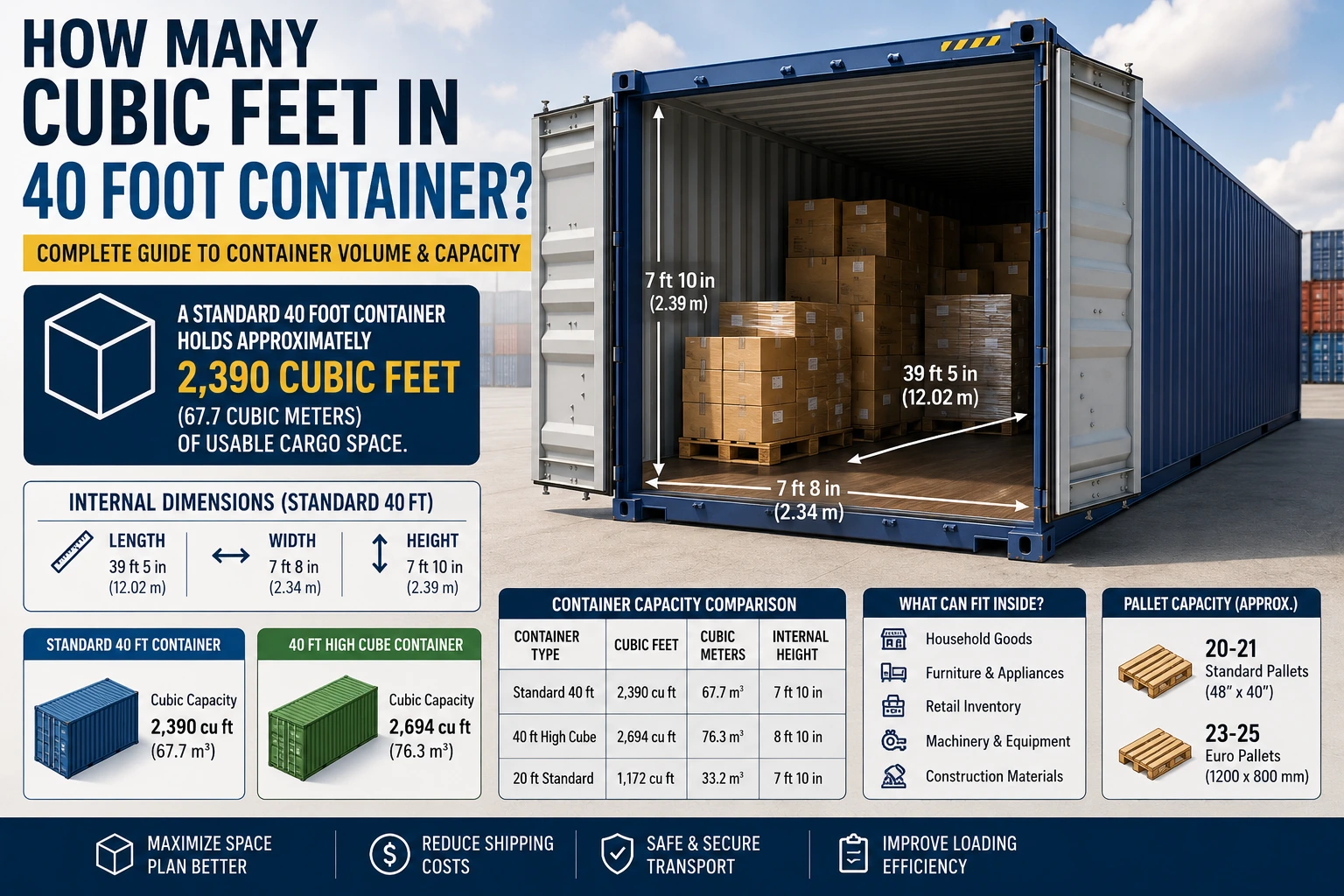
A standard 40 foot shipping container holds approximately 2,390 cubic feet of internal volume, which is equivalent to about 67.7 cubic meters.
This measurement represents the usable interior cargo space rather than the external dimensions.
Here is a quick overview.
| Container Type | Cubic Feet | Cubic Meters |
|---|---|---|
| Standard 40 Foot Container | 2,390 cu ft | 67.7 m³ |
| 40 Foot High Cube | 2,694 cu ft | 76.3 m³ |
These figures may vary slightly depending on the manufacturer, but they remain close to international standards.
Internal Dimensions
The internal dimensions determine the container’s usable cargo volume.
Typical measurements for a standard 40 foot container are:
| Dimension | Measurement |
|---|---|
| Internal Length | 39 ft 5 in |
| Internal Width | 7 ft 8 in |
| Internal Height | 7 ft 10 in |
These dimensions produce an internal capacity of approximately 2,390 cubic feet.
Because container walls and doors occupy some space, the usable interior is slightly smaller than the exterior measurements suggest.
Volume Calculation
Calculating the cubic feet of a shipping container is straightforward.
The basic formula is:
Length × Width × Height = Cubic Feet
Using standard interior dimensions:
- Length = 39.5 feet
- Width = 7.7 feet
- Height = 7.83 feet
Calculation:
39.5 × 7.7 × 7.83 ≈ 2,390 cubic feet
Shipping companies typically use standardized capacity figures rather than calculating each container individually.
Standard 40 Foot Container Capacity Chart
The table below summarizes the most important measurements.
| Specification | Standard 40 Foot Container |
|---|---|
| Exterior Length | 40 ft |
| Exterior Width | 8 ft |
| Exterior Height | 8 ft 6 in |
| Internal Length | 39 ft 5 in |
| Internal Width | 7 ft 8 in |
| Internal Height | 7 ft 10 in |
| Cubic Feet | Approximately 2,390 cu ft |
| Cubic Meters | Approximately 67.7 m³ |
| Maximum Gross Weight | Around 67,200 lbs |
| Payload Capacity | Around 58,900 lbs |
These measurements represent industry averages used by most shipping companies.
Standard vs High Cube Container
Many people compare a standard 40 foot container with a 40 foot high cube container.
The primary difference is height.
| Feature | Standard 40 Foot | High Cube 40 Foot |
|---|---|---|
| Exterior Height | 8 ft 6 in | 9 ft 6 in |
| Internal Height | 7 ft 10 in | 8 ft 10 in |
| Cubic Feet | 2,390 cu ft | 2,694 cu ft |
| Cubic Meters | 67.7 m³ | 76.3 m³ |
The high cube version provides approximately 300 additional cubic feet, making it ideal for lightweight but bulky cargo.
Why Container Volume Matters
Understanding container volume helps businesses and individuals make smarter shipping decisions.
Knowing the cubic feet allows you to:
- Estimate shipping costs
- Select the right container size
- Avoid unused cargo space
- Improve loading efficiency
- Reduce transportation expenses
- Prevent overloading
- Maximize freight value
For businesses shipping products internationally, even small improvements in loading efficiency can significantly reduce overall logistics costs.
What Can Fit Inside a 40 Foot Container?
The amount of cargo a container can hold depends on both its volume and weight limits.
A standard 40 foot container is capable of transporting large quantities of goods across many industries.
Examples include:
- Household furniture
- Office equipment
- Retail inventory
- Automotive components
- Industrial machinery
- Consumer electronics
- Packaged food products
- Clothing shipments
- Building materials
Although the container offers approximately 2,390 cubic feet of space, heavy cargo may reach the maximum weight limit before filling the entire volume.
Household Goods
A 40 foot container is a popular choice for international household relocations.
It can typically accommodate the belongings of:
- A three bedroom house
- A four bedroom home
- Large family furniture
- Kitchen appliances
- Mattresses
- Dining tables
- Boxes of personal belongings
- Outdoor furniture
Professional movers often recommend a 40 foot container for families relocating overseas because it provides enough room for both large furniture and packed household items.
Commercial Cargo
Businesses frequently use 40 foot containers to transport commercial products.
Common cargo includes:
- Retail merchandise
- Electronics
- Textiles
- Furniture
- Manufacturing equipment
- Automotive parts
- Packaged consumer goods
- Industrial supplies
Efficient stacking and pallet organization help maximize the available cubic feet while maintaining cargo safety.
Pallet Capacity
One of the easiest ways to estimate a container’s usable space is by looking at how many pallets it can hold.
Although pallet size varies by country, the following estimates apply to standard freight.
| Pallet Type | Approximate Capacity |
|---|---|
| Standard U.S. Pallets (48 × 40 in) | 20–21 pallets |
| Euro Pallets (1200 × 800 mm) | 23–25 pallets |
| Mixed Cargo | Varies depending on stacking |
Remember that the number of pallets also depends on:
- Pallet height
- Cargo weight
- Loading pattern
- Packaging type
Heavy freight may reach the weight limit before the container is completely full.
Real World Shipping Examples
Understanding practical examples makes container capacity much easier to visualize.
Example 1
Shipping Household Goods
A family moving from one country to another needs to transport:
- Living room furniture
- Bedroom sets
- Dining table
- Kitchen appliances
- Approximately 150 moving boxes
A standard 40 foot container typically provides enough space for a three to four bedroom home, making it one of the most popular choices for international relocations.
Example 2
Retail Inventory
A clothing retailer imports:
- 8,000 T-shirts
- 2,500 jackets
- Accessories
- Display equipment
Because clothing is lightweight but bulky, the shipment usually fills the container’s volume before reaching its maximum payload.
Example 3
Construction Materials
A contractor ships:
- Flooring
- Cabinets
- Windows
- Plumbing supplies
Although the total volume may remain below 2,390 cubic feet, the weight of the materials becomes the limiting factor.
This highlights why both volume and payload capacity should always be considered.
How to Calculate Cubic Feet in a Container
Calculating cargo volume helps determine whether your shipment will fit inside a container.
Step 1
Measure the length of your cargo in feet.
Step 2
Measure the width.
Step 3
Measure the height.
Step 4
Multiply the three measurements.
Length × Width × Height = Cubic Feet
For example:
A crate measures:
- Length: 8 ft
- Width: 4 ft
- Height: 5 ft
Calculation:
8 × 4 × 5 = 160 cubic feet
If your shipment totals:
- 15 crates × 160 cubic feet
Total cargo volume:
15 × 160 = 2,400 cubic feet
Since this exceeds the capacity of a standard 40 foot container, you would need either:
- A second container
- A larger shipping solution
- More efficient packing
Factors That Affect Usable Container Space
Although a standard container provides approximately 2,390 cubic feet, you rarely use every cubic foot.
Several factors reduce usable capacity.
Packaging
Large boxes often leave empty gaps.
Smaller cartons can improve packing efficiency.
Cargo Shape
Odd-shaped machinery or furniture creates unused spaces that cannot always be filled.
Weight Restrictions
Heavy cargo may exceed payload limits long before filling the available volume.
Fragile Goods
Breakable items require protective spacing, reducing usable capacity.
Loading Method
Poor stacking wastes valuable space.
Professional loading techniques maximize every available cubic foot.
Benefits of Knowing Container Capacity
Understanding container volume offers several important advantages.
Better Shipping Estimates
Accurate volume calculations reduce unexpected freight costs.
Improved Loading Efficiency
Knowing the available cubic feet helps organize cargo more effectively.
Lower Transportation Costs
Efficient loading may eliminate the need for additional containers.
Better Inventory Planning
Businesses can determine how much inventory fits into a single shipment.
Reduced Risk of Delays
Proper planning minimizes last-minute loading problems.
Expert Loading Tips
Professional freight companies recommend the following best practices.
- Measure every shipment before booking container space.
- Place heavy items on the bottom.
- Stack cartons evenly.
- Fill empty gaps whenever possible.
- Secure cargo using straps or blocking materials.
- Distribute weight evenly across the floor.
- Protect fragile goods with proper packaging.
- Leave access to important cargo when necessary.
- Double-check both weight and volume before shipping.
- Consult your freight forwarder for specialized cargo.
These practices improve safety while maximizing container capacity.
Common Mistakes
Many first-time shippers make avoidable mistakes when estimating container space.
Using Exterior Dimensions
Always calculate cargo capacity using interior dimensions, not exterior measurements.
Ignoring Weight Limits
Even if your cargo fits by volume, it may exceed the maximum payload.
Forgetting Packaging Materials
Boxes, pallets, and protective materials consume valuable space.
Poor Cargo Organization
Random loading often wastes hundreds of cubic feet.
Overestimating Capacity
Leaving a small safety margin makes loading easier and helps prevent damage.
FAQs
How many cubic feet are in a standard 40 foot shipping container?
A standard 40 foot shipping container holds approximately 2,390 cubic feet or about 67.7 cubic meters of internal cargo space.
How many cubic feet does a 40 foot high cube container hold?
A 40 foot high cube container provides approximately 2,694 cubic feet, offering around 300 additional cubic feet compared to a standard container.
How many pallets fit in a 40 foot container?
Most standard 40 foot containers hold approximately 20 to 21 U.S. pallets or 23 to 25 Euro pallets, depending on loading configuration.
Can I calculate container volume myself?
Yes. Multiply the interior length × width × height to determine the container’s cubic feet.
What limits container capacity more, weight or volume?
It depends on the cargo. Lightweight products usually reach the volume limit first, while dense materials such as machinery or construction supplies often reach the weight limit before filling the container.
Conclusion
Understanding how many cubic feet in 40 foot container is essential for efficient shipping, storage, and logistics planning. A standard 40 foot shipping container offers approximately 2,390 cubic feet of usable interior space, while a high cube version increases capacity to about 2,694 cubic feet. By considering both volume and weight limits, measuring cargo accurately, and following efficient loading practices, you can maximize container space, reduce transportation costs, and avoid common shipping mistakes. Whether you’re relocating a household, importing retail goods, or managing commercial freight, knowing your container’s capacity helps ensure smoother, more cost-effective shipments.
Discover more