
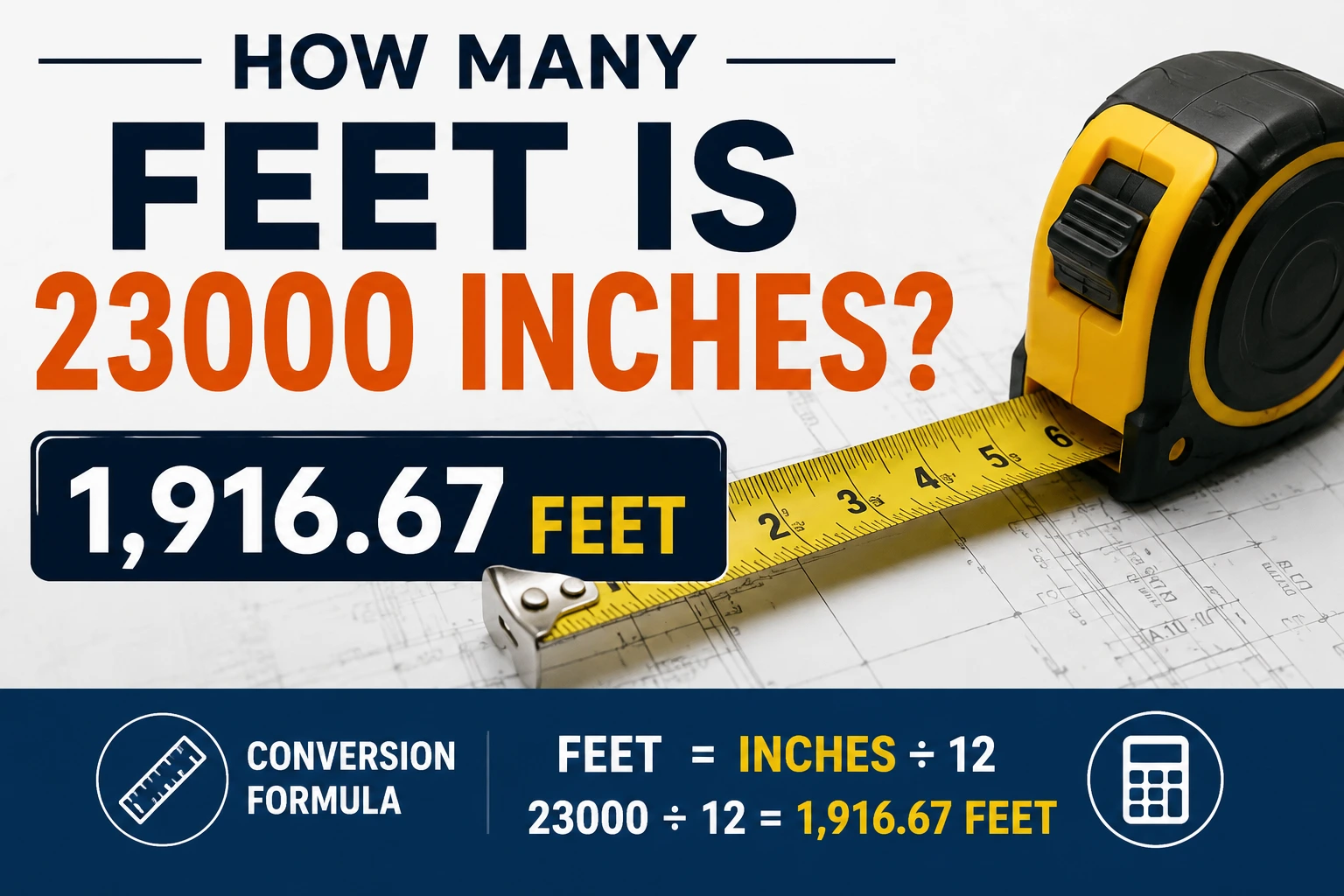
If you’ve been asking how many feet is 23000 inches, the answer is simple:
23,000 inches = 1,916.67 feet (approximately).
Whether you’re measuring construction materials, planning a large building project, calculating land dimensions, or working with engineering drawings, converting inches into feet is an important skill. Since many industries use both units interchangeably, understanding how the conversion works helps reduce mistakes and improves accuracy.
In this guide, you’ll learn the exact calculation, the conversion formula, practical examples, and where this measurement is commonly used.
The Quick Answer
Here is the exact conversion:
| Measurement | Result |
|---|---|
| 23,000 inches | 1,916.67 feet |
Since 1 foot equals 12 inches, simply divide the total inches by 12.
23,000 ÷ 12 = 1,916.6667 feet
Rounded to two decimal places:
23,000 inches = 1,916.67 feet
Understanding Inches and Feet
Before converting measurements, it’s useful to understand these two units.
What Is an Inch?
An inch is a unit of length used in the Imperial and U.S. customary systems.
It is commonly used for measuring:
- Furniture
- Electronics
- Lumber
- Fabric
- Household items
- Small construction materials
One inch is represented as:
- in
- “
Example:
- 24 inches
- 60 inches
- 96 inches
What Is a Foot?
A foot is a larger unit of length.
One foot contains:
12 inches
It is commonly represented as:
- ft
- ‘
Feet are widely used when measuring:
- Buildings
- Rooms
- Roads
- Property
- Ceiling height
- Lumber
- Landscaping
Because one foot equals twelve inches, converting between these units is straightforward.
How to Convert 23000 Inches to Feet
The process involves one simple calculation.
Formula
Feet = Inches ÷ 12
Insert the value:
Feet = 23,000 ÷ 12
Calculation:
Feet = 1,916.6667
Rounded:
Feet = 1,916.67 feet
Therefore,
23,000 inches equals approximately 1,916.67 feet.
Inches to Feet Formula
Whenever you need to convert inches into feet, use this equation:
Feet = Inches ÷ 12
Let’s apply it to several examples.
| Inches | Calculation | Feet |
|---|---|---|
| 12 | 12 ÷ 12 | 1 ft |
| 60 | 60 ÷ 12 | 5 ft |
| 120 | 120 ÷ 12 | 10 ft |
| 240 | 240 ÷ 12 | 20 ft |
| 600 | 600 ÷ 12 | 50 ft |
| 1,200 | 1,200 ÷ 12 | 100 ft |
| 23,000 | 23,000 ÷ 12 | 1,916.67 ft |
This formula works for every inch measurement.
Why Do We Divide by 12?
The reason is simple.
Every foot contains 12 inches.
That means every group of 12 inches becomes one foot.
For example:
- 12 inches = 1 foot
- 24 inches = 2 feet
- 120 inches = 10 feet
- 1,200 inches = 100 feet
- 23,000 inches = 1,916.67 feet
This relationship makes conversions quick and accurate.
Conversion Chart for Common Inch Values
The table below shows frequently converted measurements.
| Inches | Feet |
|---|---|
| 120 | 10 ft |
| 240 | 20 ft |
| 360 | 30 ft |
| 480 | 40 ft |
| 600 | 50 ft |
| 720 | 60 ft |
| 960 | 80 ft |
| 1,200 | 100 ft |
| 2,400 | 200 ft |
| 6,000 | 500 ft |
| 12,000 | 1,000 ft |
| 23,000 | 1,916.67 ft |
This chart is useful when estimating large measurements without performing calculations each time.
Real-Life Examples of 1,916.67 Feet
Large measurements can be difficult to visualize. Here are some practical examples to help you understand how long 1,916.67 feet really is.
Nearly One-Third of a Mile
One mile equals 5,280 feet.
Since 1,916.67 feet is about 36% of a mile, it’s a distance you could walk in several minutes at an average pace.
Large Construction Site
A construction project may require utility lines, fencing, or foundations extending close to 1,900 feet, making this conversion useful for contractors and engineers.
Manufacturing Facilities
Factories often produce cables, pipes, or conveyor systems measured in thousands of inches. Converting those measurements into feet makes planning and installation much easier.
Sports Facilities
Several athletic fields placed end to end could approach a total length of around 1,916 feet, making this a practical comparison for understanding the scale.
Surveying Projects
Land surveyors frequently convert long measurements from inches to feet when creating property maps, site plans, or engineering drawings.
Why Inch-to-Feet Conversion Matters
Knowing how to convert inches into feet has practical value across many industries and everyday situations.
Construction
Builders regularly switch between inches and feet while reading blueprints, measuring framing materials, or planning structural layouts. Accurate conversions help prevent costly errors.
Engineering
Mechanical and civil engineers often work with detailed technical drawings where some dimensions are listed in inches and others in feet. Quick conversions improve precision and communication.
Manufacturing
Large production facilities use inch-based measurements for machinery and components, while overall layouts are commonly measured in feet. Converting between the two ensures proper equipment placement.
Interior Design
Furniture dimensions are usually provided in inches, while room sizes are measured in feet. Understanding both units helps designers and homeowners choose pieces that fit comfortably within a space.
Education
Students studying mathematics, geometry, or technical trades frequently practice converting between inches and feet. Mastering this basic calculation builds confidence and supports more advanced measurement skills
Practical Applications of Converting 23,000 Inches to Feet
Converting 23,000 inches into 1,916.67 feet is useful in many real-world situations. Whether you’re working on a construction project or simply comparing measurements, understanding this conversion can save time and improve accuracy.
Construction Projects
Construction professionals often receive measurements in inches on blueprints but discuss distances in feet on-site.
For example, if a utility line is listed as 23,000 inches, converting it to 1,916.67 feet makes it much easier to estimate material requirements and communicate with the project team.
Road and Infrastructure Planning
Engineers working on roads, sidewalks, pipelines, or drainage systems regularly convert long measurements into feet for planning and documentation.
Using feet provides a clearer understanding of the overall project length.
Manufacturing
Large manufacturing plants may produce materials such as:
- Steel cables
- Electrical wiring
- Conveyor belts
- Plastic tubing
- Fabric rolls
These products are sometimes measured in inches during production but recorded in feet for shipping and inventory.
Surveying and Land Measurement
Surveyors use precise measurements when marking property boundaries and preparing maps.
Converting long distances from inches into feet makes calculations easier and improves readability in reports.
Architecture
Architects frequently switch between inches and feet while creating building plans.
For example:
- Interior details may use inches.
- Overall building dimensions are usually shown in feet.
Understanding both units helps avoid costly design errors.
Comparing 23,000 Inches with Other Units
Sometimes converting to additional units provides better context.
| Unit | Equivalent |
|---|---|
| Inches | 23,000 |
| Feet | 1,916.67 ft |
| Yards | 638.89 yd |
| Miles | 0.363 mi |
| Centimeters | 58,420 cm |
| Meters | 584.2 m |
| Kilometers | 0.584 km |
These conversions are especially useful when working with international standards or scientific measurements.
Step-by-Step Conversion Examples
Understanding the formula becomes easier with a few examples.
Example 1
Convert 480 inches into feet.
Formula:
Feet = Inches ÷ 12
Calculation:
480 ÷ 12 = 40 feet
Example 2
Convert 1,200 inches.
1,200 ÷ 12 = 100 feet
Example 3
Convert 6,000 inches.
6,000 ÷ 12 = 500 feet
Example 4
Convert 15,000 inches.
15,000 ÷ 12 = 1,250 feet
Example 5
Convert 23,000 inches.
23,000 ÷ 12 = 1,916.67 feet
Following the same formula every time ensures consistent and accurate results.
Large Inches-to-Feet Conversion Chart
The chart below provides quick conversions for common large measurements.
| Inches | Feet |
|---|---|
| 3,000 | 250 ft |
| 6,000 | 500 ft |
| 9,000 | 750 ft |
| 12,000 | 1,000 ft |
| 15,000 | 1,250 ft |
| 18,000 | 1,500 ft |
| 21,000 | 1,750 ft |
| 23,000 | 1,916.67 ft |
| 24,000 | 2,000 ft |
| 30,000 | 2,500 ft |
| 36,000 | 3,000 ft |
This table is helpful for engineers, surveyors, contractors, and anyone working with long-distance measurements.
Common Mistakes When Converting Inches to Feet
Even though the calculation is simple, errors can happen. Here are some common mistakes to avoid.
Forgetting to Divide by 12
The most common mistake is using multiplication instead of division.
Always remember:
Feet = Inches ÷ 12
Confusing Feet with Square Feet
Feet measure length.
Square feet measure area.
For example:
- 1,916.67 feet is a linear measurement.
- 1,916.67 square feet refers to the area of a surface.
These are different types of measurements and should not be used interchangeably.
Mixing Imperial and Metric Units
Avoid combining:
- Inches
- Feet
- Meters
- Centimeters
Convert all measurements into the same unit before making calculations.
Rounding Too Early
If you round intermediate calculations too soon, your final answer may become less accurate.
For example:
23,000 ÷ 12 = 1,916.6667
Rounded correctly:
1,916.67 feet
Recording Measurements Incorrectly
Always double-check your numbers before calculating, especially when working on construction or engineering projects where small mistakes can lead to expensive corrections.
Expert Tips for Accurate Measurement Conversions
Professionals follow a few simple practices to improve accuracy.
- Verify the original measurement before converting.
- Keep a reliable calculator or conversion app available.
- Write measurements clearly to avoid transcription errors.
- Double-check calculations for large projects.
- Use conversion charts for frequently used values.
- Stay consistent with one measurement system throughout a project.
- Round only after completing the full calculation.
These habits reduce mistakes and improve efficiency.
Benefits of Understanding Inches-to-Feet Conversions
Knowing how to convert inches into feet provides several practical advantages.
- Makes large measurements easier to understand.
- Improves communication between project teams.
- Simplifies blueprint reading.
- Helps estimate materials accurately.
- Supports budgeting and cost calculations.
- Reduces measurement errors.
- Saves time during planning and installation.
Whether you’re a homeowner, student, or professional, this basic skill is valuable in many everyday situations.
FAQs
How many feet is 23,000 inches?
23,000 inches equals 1,916.67 feet. Divide 23,000 by 12 to get the answer.
What formula converts inches to feet?
Use the formula:
Feet = Inches ÷ 12
This works for any measurement in inches.
How many yards is 23,000 inches?
Since 1 yard equals 36 inches:
23,000 ÷ 36 = 638.89 yards.
How many miles is 23,000 inches?
23,000 inches is approximately 0.363 miles, making it a little over one-third of a mile.
Why do builders convert inches into feet?
Builders use feet because they are easier to read and communicate when working with long distances, building layouts, and material estimates.
Conclusion
If you were wondering how many feet is 23000 inches, the correct answer is 1,916.67 feet. You can find this by dividing 23,000 inches by 12, since one foot contains 12 inches. This simple conversion is widely used in construction, engineering, manufacturing, surveying, architecture, and many DIY projects.
Understanding how to convert inches into feet makes large measurements easier to interpret, improves planning accuracy, and reduces costly mistakes. By remembering the formula Feet = Inches ÷ 12, using conversion charts, and checking your calculations carefully, you can confidently convert any inch measurement into feet for personal, academic, or professional use.
Discover more