

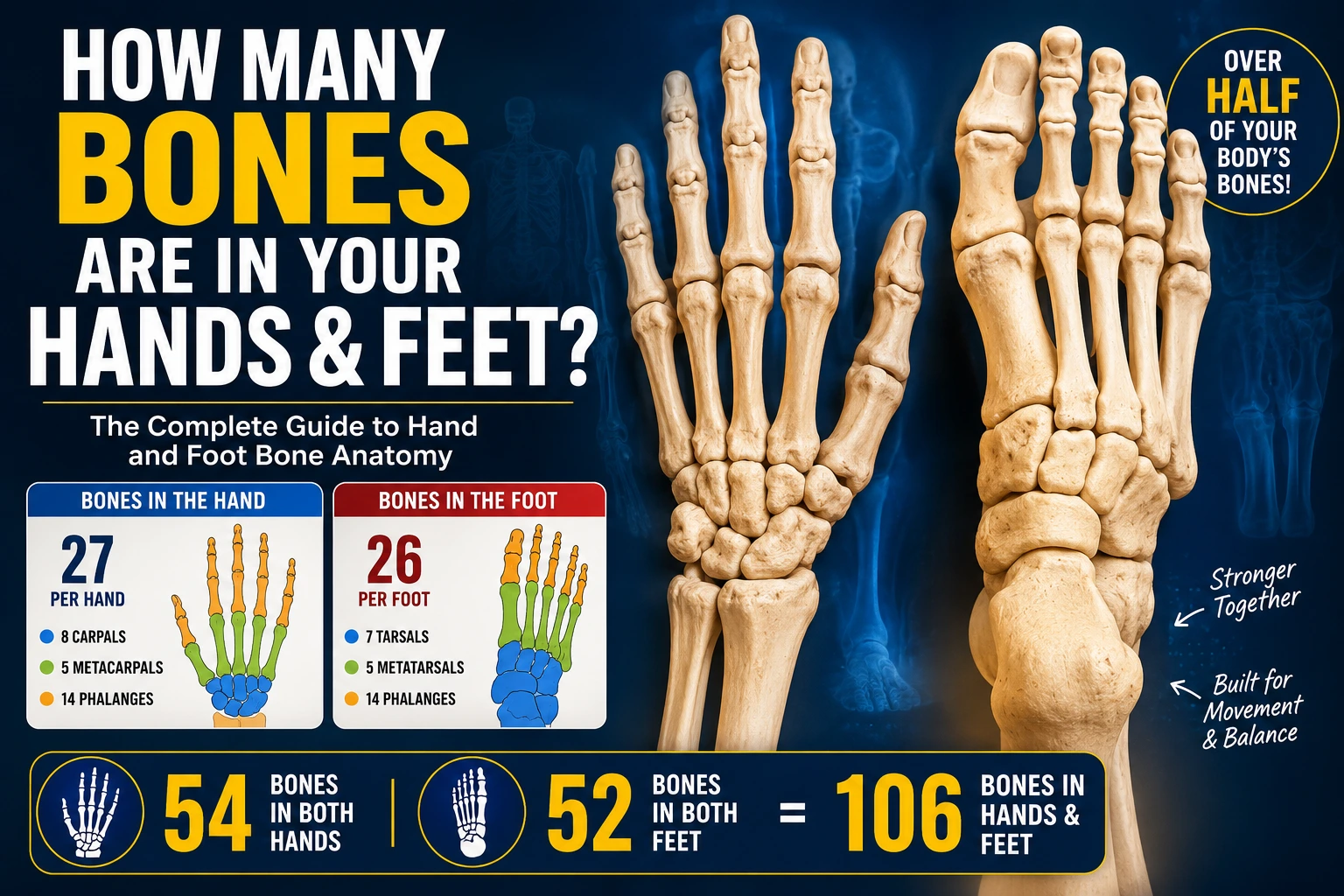
Have you ever wondered how many bones are in your hands and feet? Most people know that the human body contains hundreds of bones, but few realize that a surprisingly large percentage of them are located in the hands and feet.
In fact, your hands and feet contain more than half of all the bones in your body. These bones work together to help you walk, run, grasp objects, write, type, play sports, and maintain balance every day.
Understanding the anatomy of your hands and feet can give you a greater appreciation for how the human body functions. In this guide, we’ll explore exactly how many bones are found in your hands and feet, what they are called, how they work, and why they are so important.
Quick Answer
If you’re looking for the short answer to how many bones are in your hands and feet, here it is:
| Body Part | Number of Bones |
|---|---|
| One Hand | 27 |
| Both Hands | 54 |
| One Foot | 26 |
| Both Feet | 52 |
| Hands and Feet Combined | 106 |
Key Fact
The adult human body contains 206 bones.
Since hands and feet contain 106 bones together, they account for:
206106×100≈51.5%
That means more than half of your body’s bones are located in your hands and feet.
Understanding the Human Skeleton
Before looking at individual bones, it helps to understand where hands and feet fit into the skeletal system.
Total Number of Bones in the Adult Body
A healthy adult typically has 206 bones.
These bones form the body’s framework and provide:
- Structure
- Protection for organs
- Movement
- Support
- Mineral storage
- Blood cell production
However, babies are born with approximately 270 bones. As they grow, some bones fuse together, resulting in the 206 bones found in adulthood.
Why Hands and Feet Contain So Many Bones
Hands and feet perform complex tasks.
Your hands allow:
- Writing
- Grasping
- Throwing
- Typing
- Drawing
Your feet allow:
- Walking
- Running
- Jumping
- Balancing
- Standing
To perform these activities efficiently, the body requires many small bones connected by joints, muscles, tendons, and ligaments.
How Many Bones Are in Your Hands and Feet?
Let’s break the numbers down.
Bones in Each Hand
Each hand contains:
27 Bones
These are divided into:
| Bone Group | Number |
|---|---|
| Carpals | 8 |
| Metacarpals | 5 |
| Phalanges | 14 |
| Total | 27 |
Bones in Both Hands
Since each hand contains 27 bones:
27 × 2 = 54
So both hands contain:
54 bones
Bones in Each Foot
Each foot contains:
26 Bones
These are divided into:
| Bone Group | Number |
|---|---|
| Tarsals | 7 |
| Metatarsals | 5 |
| Phalanges | 14 |
| Total | 26 |
Bones in Both Feet
26 × 2 = 52
Both feet contain:
52 bones
Total Bones in Hands and Feet
Combining both hands and feet:
54 + 52 = 106
Therefore:
Hands and feet together contain 106 bones.
This is one of the most fascinating facts about human anatomy.
Bones of the Hand Explained
The hand contains three main groups of bones.
Carpals
The carpals form the wrist.
There are eight carpal bones in each hand.
These bones allow the wrist to move in multiple directions.
Examples include:
- Scaphoid
- Lunate
- Triquetrum
- Pisiform
- Trapezium
- Trapezoid
- Capitate
- Hamate
Together, they provide flexibility and strength.
Metacarpals
The metacarpals form the palm.
Each hand contains five metacarpal bones.
These connect the wrist bones to the fingers.
You can often feel your metacarpals when you make a fist.
Phalanges
Phalanges are the finger bones.
Each hand contains 14 phalanges:
- Three bones in each finger
- Two bones in the thumb
These bones allow precise finger movements and gripping actions.
Bones of the Foot Explained
The foot also contains three major groups of bones.
Tarsals
The tarsals form the rear and middle part of the foot.
There are seven tarsal bones:
- Talus
- Calcaneus
- Navicular
- Cuboid
- Medial cuneiform
- Intermediate cuneiform
- Lateral cuneiform
The calcaneus is the heel bone and the largest bone in the foot.
Metatarsals
The metatarsals are the long bones in the middle of the foot.
Each foot contains five metatarsals.
These help distribute body weight while walking and running.
Phalanges
The toes contain 14 phalanges.
Just like the fingers:
- Each toe has three phalanges
- The big toe has only two
These bones help with balance and propulsion during movement.
Hand and Foot Bone Comparison Table
| Feature | Hand | Foot |
|---|---|---|
| Total Bones | 27 | 26 |
| Small Bones | Yes | Yes |
| Primary Function | Grasping | Support |
| Wrist/Ankle Bones | 8 Carpals | 7 Tarsals |
| Middle Bones | 5 Metacarpals | 5 Metatarsals |
| Digit Bones | 14 Phalanges | 14 Phalanges |
Although similar in structure, hands and feet have evolved for different purposes.
Why Do Hands and Feet Have So Many Bones?
Many people are surprised to learn that more than half the body’s bones are located in these areas.
There are several reasons.
Precision Movements
The hand performs highly detailed tasks.
Examples include:
- Buttoning a shirt
- Using a smartphone
- Playing a musical instrument
- Writing with a pencil
Multiple small bones provide flexibility and control.
Balance and Stability
The foot must support the body’s entire weight.
Its many bones help distribute pressure evenly across the ground.
This improves stability and reduces strain.
Shock Absorption
Every step creates force.
The numerous bones, joints, and arches of the foot help absorb impact and protect the body from injury.
How Hands and Feet Work Together
Hands and feet are designed for different jobs, but they work together constantly.
For example:
When climbing stairs:
- Feet provide support
- Hands grip railings
When playing sports:
- Feet create movement
- Hands control equipment
When carrying objects:
- Hands hold items
- Feet maintain balance
This cooperation allows humans to perform complex activities efficiently.
Common Injuries Affecting Hand and Foot Bones
Because hands and feet are used constantly, they are vulnerable to injury.
Hand Injuries
Common examples include:
- Finger fractures
- Thumb sprains
- Wrist fractures
- Dislocations
The scaphoid bone is one of the most commonly fractured wrist bones.
Foot Injuries
Common foot injuries include:
- Toe fractures
- Stress fractures
- Heel injuries
- Metatarsal fractures
Athletes frequently experience foot injuries due to repetitive impact.
Interesting Facts About Hand and Foot Bones
Here are some fascinating anatomy facts:
1. Your Hands Contain 27 Bones Each
That’s nearly one-eighth of all bones in the body.
2. The Foot Has 33 Joints
These joints allow flexibility and movement.
3. The Heel Bone Is the Largest Foot Bone
The calcaneus absorbs tremendous force during walking and running.
4. Finger Bones Are Called Phalanges
The same term is used for toe bones.
5. More Than Half Your Bones Are in Your Hands and Feet
Together, they contain 106 of the body’s 206 bones.
Expert Tips for Keeping Your Bones Healthy
Healthy bones support mobility throughout life.
Eat Bone-Friendly Foods
Focus on:
- Dairy products
- Leafy greens
- Fish
- Nuts
- Fortified foods
Get Enough Vitamin D
Vitamin D helps the body absorb calcium effectively.
Stay Active
Weight-bearing activities strengthen bones.
Examples include:
- Walking
- Hiking
- Dancing
- Strength training
Wear Proper Footwear
Supportive shoes help protect foot bones and joints.
Prevent Falls
Falls are a leading cause of fractures, especially among older adults.
9. FAQs
1. How many bones are in both hands and feet combined?
There are 106 bones in both hands and feet combined.
2. How many bones are in one hand?
One hand contains 27 bones consisting of carpals, metacarpals, and phalanges.
3. How many bones are in one foot?
One foot contains 26 bones made up of tarsals, metatarsals, and phalanges.
4. Why do hands and feet have so many bones?
Many small bones provide flexibility, balance, stability, dexterity, and shock absorption.
5. Do children have the same number of bones as adults?
No. Babies are born with about 270 bones, many of which fuse together as they grow.
10. Conclusion
If you’ve ever wondered how many bones are in your hands and feet, the answer is surprisingly impressive. Each hand contains 27 bones, each foot contains 26 bones, and together your hands and feet hold 106 bones—more than half of the 206 bones in the adult human body.
These bones play essential roles in movement, balance, coordination, and everyday tasks. From gripping a pencil to running across a field, the intricate structure of the hands and feet allows humans to perform countless activities with remarkable precision. Understanding their anatomy not only answers a common question but also highlights the incredible design of the human skeletal system.
Discover more