

If you’re setting up a game in your backyard, at a tailgate party, or for an official tournament, one of the first questions you’ll ask is cornhole how many feet apart should the boards be? The correct distance affects fairness, gameplay, and overall enjoyment.
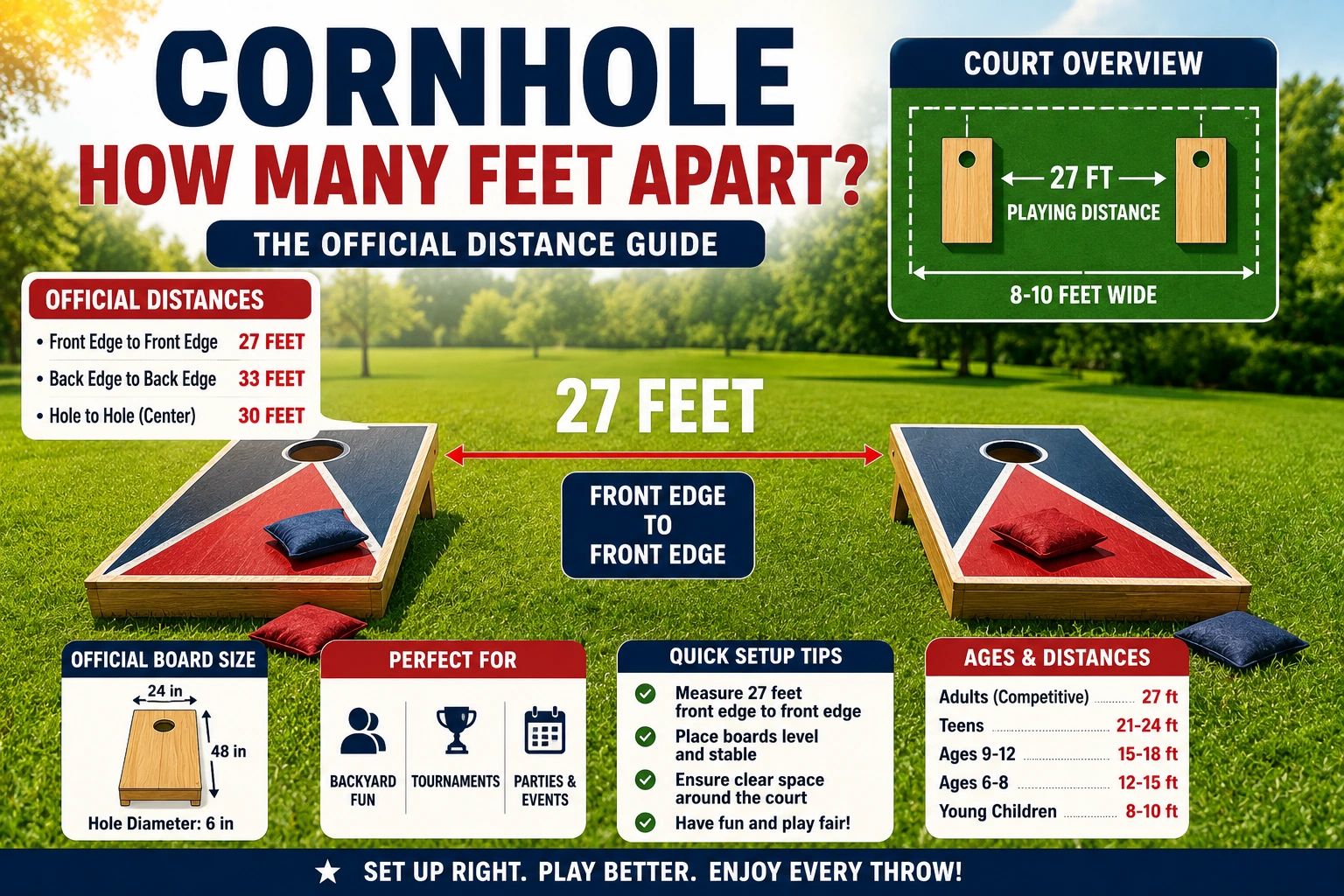
According to official cornhole regulations, the front edges of the boards should be 27 feet apart for adult play. This measurement creates the standard throwing distance used in leagues and tournaments. For children or casual games, the boards can be placed closer together to make the game more enjoyable.
In this guide, you’ll learn the official board spacing, court dimensions, setup instructions, age-specific distances, common mistakes to avoid, and expert tips for creating the perfect cornhole playing area.
Quick Answer
The official distance between cornhole boards is:
- 27 feet from the front edge of one board to the front edge of the other
- Approximately 33 feet from the back edge of one board to the back edge of the other
Official Cornhole Measurements
| Measurement | Distance |
|---|---|
| Front Edge to Front Edge | 27 feet |
| Back Edge to Back Edge | 33 feet |
| Hole Diameter | 6 inches |
| Board Length | 48 inches |
| Board Width | 24 inches |
| Front Height | 3–4 inches |
| Back Height | 12 inches |
Official Cornhole Board Distance
If you’re wondering cornhole how many feet apart the boards should be, the answer depends on whether you’re playing recreationally or following official rules.
For adult games and tournaments:
- 27 feet separates the front edges of both boards.
This standard distance is recognized by professional organizations and provides a balanced level of challenge for players of all skill levels.
Distance Between Front Edges
Always measure from the front edge of one board to the front edge of the other.
Many beginners mistakenly measure from the back or center of the boards, resulting in an incorrect playing distance.
Distance Between Holes
Since each board is 4 feet long, the center holes are farther apart.
The distance from the center of one hole to the center of the opposite hole is approximately 30 feet.
This is the distance players effectively throw during the game.
Official Cornhole Court Dimensions
Proper spacing involves more than just placing two boards on the ground.
A regulation court includes additional measurements that improve gameplay and player safety.
Court Width
A typical cornhole court measures:
- 8–10 feet wide
This allows enough room for throwing and player movement.
Pitcher’s Box
Each side of the board includes a designated pitching area.
Players must throw while remaining within this box to ensure fair play.
Foul Lines
The front edge of each board serves as the foul line.
Players should not step beyond this line while releasing the bean bag.
Cornhole Distances by Age Group
Not everyone needs to play from the official tournament distance.
Here’s a recommended guide.
| Age Group | Board Distance |
|---|---|
| Adults | 27 feet |
| Teenagers | 21–24 feet |
| Ages 9–12 | 15–18 feet |
| Ages 6–8 | 12–15 feet |
| Young Children | 8–10 feet |
Reducing the distance helps younger players develop confidence and accuracy.
How to Measure Cornhole Board Distance
Setting up your boards correctly takes only a few minutes.
Step 1
Choose a flat playing surface.
Grass, concrete, patios, and gym floors all work well.
Step 2
Position the first board.
Ensure it’s level and stable.
Step 3
Measure 27 feet from the front edge.
Use a tape measure for accuracy.
Step 4
Place the second board.
The front edge should line up exactly with the 27-foot mark.
Step 5
Check alignment.
The boards should face each other directly without any angle.
Step 6
Start playing.
Proper spacing creates a consistent and enjoyable experience.
Cornhole Board Size Requirements
Official boards follow standardized dimensions.
| Feature | Measurement |
|---|---|
| Length | 48 inches |
| Width | 24 inches |
| Hole Diameter | 6 inches |
| Hole Center | 9 inches from top |
| Hole Center | 12 inches from each side |
| Front Height | 3–4 inches |
| Back Height | 12 inches |
These specifications ensure every tournament board plays the same way.
Why the Official Distance Matters
Using the proper board spacing offers several benefits.
Fair Competition
Everyone throws from the same distance.
This creates balanced gameplay.
Skill Development
Consistent practice at regulation distance improves:
- Accuracy
- Throwing technique
- Bag control
- Scoring consistency
Tournament Preparation
If you plan to compete, practicing at the official distance helps you adjust to league conditions.
Better Game Flow
Correct spacing keeps games challenging without making them frustrating.
Common Mistakes When Setting Up Cornhole
Avoid these setup errors.
Measuring Incorrectly
Always measure:
Front edge to front edge
Not:
- Back edge
- Center
- Hole-to-hole
Uneven Ground
Boards placed on slopes affect:
- Bag slide
- Bounce
- Accuracy
Whenever possible, use a flat surface.
Wrong Board Angle
The rear of the board should be about 12 inches high.
Incorrect angles change how bags slide toward the hole.
Insufficient Playing Space
Leave enough room around the court.
Players need space for:
- Throwing
- Walking
- Spectators
Expert Tips for the Perfect Cornhole Setup
Experienced players recommend a few simple practices.
Use a Tape Measure
Guessing often results in uneven board spacing.
A tape measure ensures consistency every time.
Keep Boards Parallel
Both boards should align perfectly.
Even slight angles can affect gameplay.
Secure Lightweight Boards
On windy days, lightweight boards may shift.
Use rubber feet or weighted bases if needed.
Maintain the Playing Surface
Remove:
- Rocks
- Sticks
- Wet leaves
A clean surface improves safety and playability.
Indoor vs Outdoor Cornhole Setup
Cornhole works well in different environments.
Outdoor Setup
Ideal surfaces include:
- Grass
- Concrete
- Patios
- Driveways
Ensure there are no low tree branches or obstacles.
Indoor Setup
Gymnasiums, garages, and recreation halls are excellent choices.
When playing indoors:
- Leave additional clearance around the court.
- Protect floors with soft-bottom bean bags if necessary.
- Ensure adequate lighting for better visibility.
Frequently Asked Questions
How many feet apart should cornhole boards be?
Official cornhole boards should be 27 feet apart, measured from the front edge of one board to the front edge of the other.
Do you measure from the front or back of the boards?
Measure from the front edge of each board. This is the official standard used in tournaments and recreational leagues.
What is the distance between cornhole holes?
The center of each hole is approximately 30 feet apart when regulation boards are set up correctly.
What is the cornhole distance for kids?
Children often play at shorter distances, typically between 8 and 18 feet, depending on age and skill level.
Can I adjust the distance for casual games?
Yes. Many families and backyard players shorten the distance to make the game more enjoyable for beginners and younger participants.
Conclusion
Knowing cornhole how many feet apart the boards should be is essential for creating a fun and fair playing experience. For official games, the front edges of the boards must be 27 feet apart, while the centers of the holes are about 30 feet apart. These measurements ensure consistency across recreational and competitive play.
Whether you’re hosting a backyard barbecue, organizing a neighborhood tournament, or practicing for league competition, setting up your cornhole boards correctly will improve gameplay, accuracy, and enjoyment. Keep a tape measure handy, use the official dimensions, and you’ll be ready for hours of competitive fun.
Discover more