

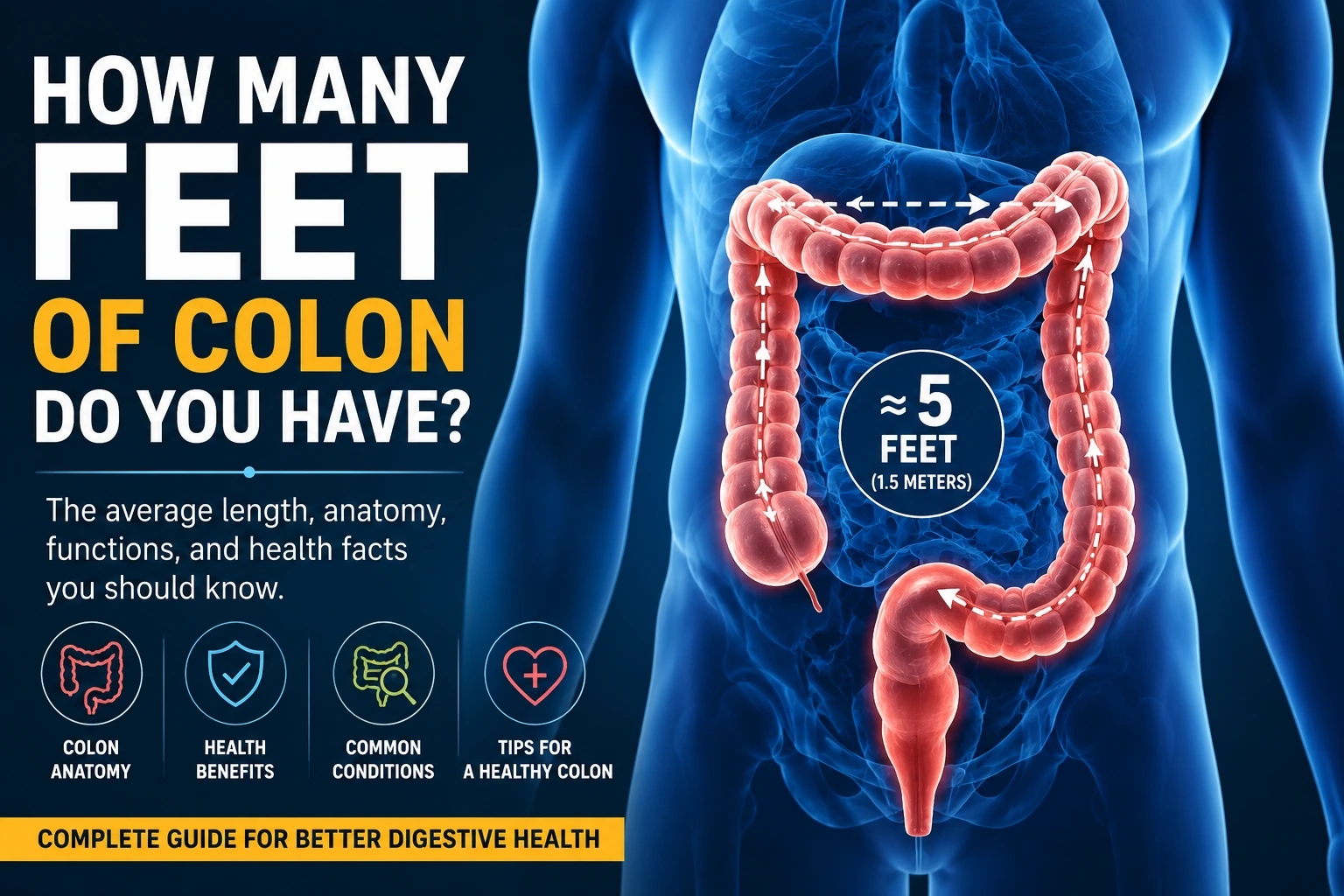
If you’ve ever wondered how many feet of colon do you have, you’re not alone. It’s a surprisingly common question because the colon plays a major role in digestion and overall health. Although it fits neatly inside your abdomen, the colon is much longer than most people expect.
The average adult colon measures about 5 feet (1.5 meters) in length. Together with the rectum, it forms the largest part of the large intestine and helps absorb water, process waste, and prepare stool for elimination.
Understanding the colon’s length, structure, and function can help you appreciate how your digestive system works. Whether you’re studying anatomy, preparing for a medical exam, or simply curious, this guide explains everything in simple language.
Quick Answer
The average human colon is approximately:
| Measurement | Length |
|---|---|
| Feet | About 5 feet |
| Inches | About 60 inches |
| Meters | About 1.5 meters |
| Centimeters | About 150 cm |
Although 5 feet is considered average, some people naturally have slightly shorter or longer colons.
What Is the Colon?
The colon is the largest section of the large intestine. It begins where the small intestine ends and continues until the rectum.
Its main jobs include:
- Absorbing water
- Absorbing electrolytes
- Breaking down remaining food with the help of beneficial bacteria
- Forming solid waste
- Storing stool before a bowel movement
The colon is not responsible for digesting most nutrients. That work mainly happens in the stomach and small intestine.
Difference Between the Colon and Large Intestine
Many people use the terms interchangeably, but they are not exactly the same.
| Large Intestine | Colon |
|---|---|
| Includes the cecum, colon, rectum, and anal canal | Refers only to the main middle portion |
| Entire organ | One major section of the large intestine |
So while the colon is part of the large intestine, it is not the entire large intestine.
How Many Feet of Colon Do You Have?
The answer for most healthy adults is around 5 feet.
Doctors estimate the average colon length to be between:
- 4.5 feet
- 5 feet
- 6 feet
The exact measurement depends on several factors including:
- Genetics
- Body size
- Age
- Individual anatomy
Unlike height, colon length cannot be measured from outside the body. It is typically measured during surgery, imaging studies, or anatomical research.
Average Adult Colon Length
Here is a quick overview.
| Group | Average Colon Length |
|---|---|
| Adult women | Around 5 feet |
| Adult men | Around 5 feet |
| Tall individuals | May be slightly longer |
| Children | Shorter and grows with age |
There is no single “perfect” colon length because natural variation exists.
Does Colon Length Vary?
Yes.
Just as people have different heights and arm lengths, colon length varies from person to person.
Some individuals naturally have:
- Extra loops
- Slightly longer sections
- More flexible positioning
These differences usually cause no health problems.
However, an unusually long colon, sometimes called a redundant colon, may increase the chance of constipation or twisting of the bowel in certain people.
Parts of the Colon
The colon consists of several connected sections.
Ascending Colon
Located on the right side of the abdomen, the ascending colon carries waste upward from the cecum.
Functions include:
- Water absorption
- Beginning stool formation
Average length:
Approximately 8 inches.
Transverse Colon
The transverse colon stretches across the upper abdomen.
Functions include:
- Continued water absorption
- Bacterial fermentation
- Movement of waste
Average length:
Around 18 inches, making it the longest section.
Descending Colon
This section travels down the left side of the abdomen.
Its main purpose is to:
- Store increasingly solid waste
- Continue absorbing water
Average length:
Approximately 10 inches.
Sigmoid Colon
The sigmoid colon has an S-shaped curve leading toward the rectum.
Its job is to:
- Hold stool before elimination
- Move waste into the rectum
Average length:
About 16 inches.
Rectum
Although technically separate from the colon, the rectum stores stool before a bowel movement.
Average length:
- Around 5 to 6 inches
Why Is the Colon So Long?
You might wonder why a 5-foot organ fits inside your abdomen.
The answer is simple.
The colon is folded into several curves and loops, allowing a long digestive tube to fit within a relatively small space.
This extra length provides more surface area for:
- Water absorption
- Mineral absorption
- Healthy bacteria
- Waste processing
Without sufficient length, your body would struggle to recover enough water from food waste.
Colon Length Comparison Table
| Organ | Average Length |
|---|---|
| Esophagus | 10 inches |
| Stomach | Around 12 inches |
| Small intestine | 20–22 feet |
| Colon | About 5 feet |
| Entire digestive tract | Around 25–30 feet |
As you can see, the small intestine is much longer than the colon.
What Does the Colon Do?
The colon performs several essential functions every day.
Absorbs Water
The colon removes excess water from food waste.
Without this process, diarrhea would occur continuously.
Supports Good Bacteria
Trillions of beneficial bacteria live inside the colon.
These bacteria help:
- Produce vitamins
- Protect against harmful germs
- Improve digestion
- Support immunity
Forms Stool
After nutrients have been absorbed, the colon compacts remaining waste into stool.
Stores Waste
The sigmoid colon and rectum temporarily hold stool until you have a bowel movement.
Factors That Affect Colon Length
Several factors influence colon size.
Genetics
Some families naturally have slightly longer colons.
Body Size
Larger individuals may have somewhat longer digestive organs.
Age
The colon grows during childhood and reaches adult size in early adulthood.
Medical Conditions
Certain conditions may stretch or enlarge parts of the colon, including:
- Chronic constipation
- Redundant colon
- Megacolon
- Hirschsprung disease (rare)
These conditions should be evaluated by a healthcare professional.
Common Colon Conditions
Although the colon is resilient, several health problems can affect it.
Constipation
Slow-moving stool causes difficulty passing waste.
Symptoms include:
- Hard stools
- Infrequent bowel movements
- Abdominal discomfort
Colon Polyps
Polyps are growths inside the colon.
Most are harmless, but some can become cancerous over time.
Routine screenings help detect them early.
Diverticulosis
Small pouches can develop in the colon wall.
Many people never experience symptoms.
However, infection of these pouches causes diverticulitis.
Colorectal Cancer
Cancer can develop anywhere in the colon or rectum.
Regular screening significantly improves early detection.
Inflammatory Bowel Disease (IBD)
Conditions such as ulcerative colitis and Crohn’s disease cause chronic inflammation that affects the digestive tract.
Tips for Keeping Your Colon Healthy
Healthy daily habits support proper colon function.
Eat More Fiber
Good sources include:
- Fruits
- Vegetables
- Whole grains
- Beans
- Lentils
Aim for about 25–38 grams of fiber daily, depending on age and sex.
Drink Plenty of Water
Hydration keeps stool soft and easier to pass.
Exercise Regularly
Physical activity encourages healthy bowel movements.
Even a daily 30-minute walk can help.
Limit Processed Foods
Reduce:
- Sugary snacks
- Highly processed meals
- Excess red meat
Instead, choose fresh, nutrient-rich foods.
Get Recommended Screenings
Adults at average risk are generally advised to begin colorectal cancer screening at age 45, though individual recommendations may vary based on personal and family medical history.
Don’t Ignore Symptoms
Seek medical advice if you notice:
- Blood in stool
- Ongoing abdominal pain
- Unexplained weight loss
- Persistent constipation
- Lasting diarrhea
Early evaluation often leads to better outcomes.
Myths About Colon Length
Many misconceptions surround the colon.
| Myth | Reality |
|---|---|
| Everyone has exactly a 5-foot colon | Length naturally varies |
| Longer colon means better digestion | Function matters more than length |
| Colon cleanses remove toxins | Your colon naturally removes waste |
| Colon size changes after eating | Food does not permanently stretch the colon |
| A longer colon is always unhealthy | Many people have longer colons without problems |
Understanding these facts helps separate medical science from common myths.
FAQs
1. How many feet of colon do you have on average?
Most adults have a colon measuring approximately 5 feet (1.5 meters) long.
2. Is the colon longer than the small intestine?
No. The small intestine averages 20–22 feet, making it much longer than the colon.
3. Can a person’s colon be longer than average?
Yes. Some people naturally have a redundant or longer colon without experiencing symptoms.
4. Does colon length affect digestion?
Not usually. The colon’s overall health and function are generally more important than its exact length.
5. How can I keep my colon healthy?
Eat a high-fiber diet, stay hydrated, exercise regularly, avoid smoking, limit processed foods, and follow recommended colorectal screening guidelines.
Conclusion
If you’ve been asking how many feet of colon do you have, the simple answer is about 5 feet for the average adult. Despite fitting comfortably inside your abdomen, the colon is carefully folded to maximize its ability to absorb water, support beneficial gut bacteria, and prepare waste for elimination.
While colon length varies slightly between individuals, these differences are usually normal and do not affect digestive health. Maintaining a fiber-rich diet, drinking enough water, staying active, and following recommended screening guidelines are the most effective ways to support a healthy colon throughout life. Understanding your colon’s anatomy and function can also help you recognize when changes in bowel habits or persistent symptoms deserve medical attention.
Discover more